
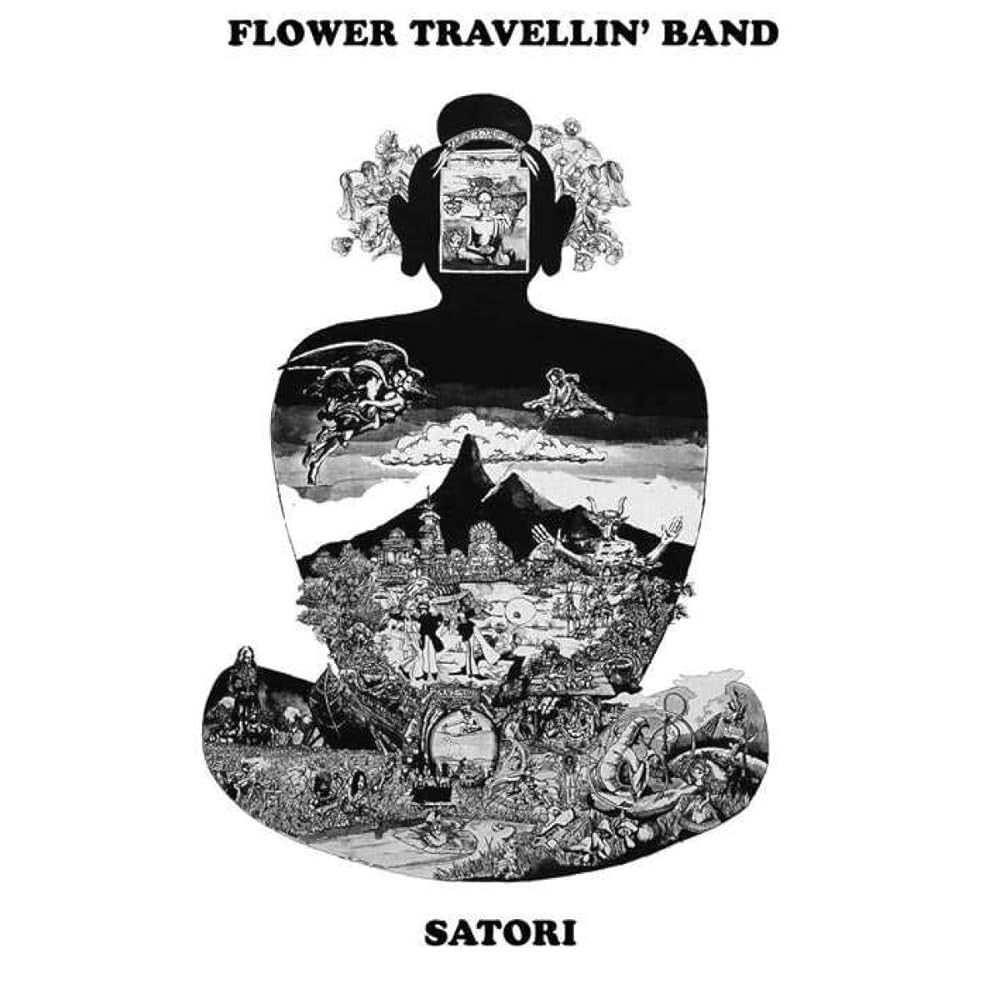
Most known today for their 1971 proto-doom metal album, “Satori,” The Flower Travellin’ Band have an interesting history of attempting to bring a heavy rock sound to Japan and in their later careers, the singer had many successful albums including one with The Wailers and the guitarist created his own instrument known as the Sitarla. Watch this video to the end to learn the full history of this radical group!
Singer, actor and record producer, Yuya Uchida, had begun releasing singles back in 1963 and had released 2 albums before getting the opportunity to open for The Beatles when they toured Japan in 1966. He befriended John Lennon and later went to England to visit him there where he was able to see Jimi Hendrix perform and have his mind blown by hearing Cream.
He wanted to introduce this heavier psychedelic sound to his home country and created a band which he called Yuya Uchida & The Flowers. Their album “Challenge!” released in July of 1969 only included one original song while the others are covers of songs by Big Brother and the Holding Company, Cream, Hendrix, and Jefferson Airplane. None of the covers here are different enough from the original versions to go out of your way for but I thought the female singer’s ability to imitate Janis Joplin was pretty impressive and some others online seem to enjoy their cover of “White Room.” All of the band members appear naked on the album cover as a way to spark some controversy and get some buzz around the group.
After this recording, Yuya Uchida decided to totally reform the band as Flower Travellin’ Band and take a step back from being a vocalist to become strictly the manager and producer. Joji “George” Wada from the previous lineup remained on the drums and 3 dudes from other popular Group Sounds bands were brought into the group. Bassist Jun Kozuki came from the band The Taxman, Hideki Ishima came from The Beavers and played lead guitar and sitar, and Akira “Joe” Yamanaka was a professional boxer, an actor, and was the singer of 4/9/1. He never knew his African-American father and unfortunately lost his mother at a young age.
While still unaware of exactly what the direction of the band would be, the group recorded a 27 minute psychedelic freak out jam, more in the style of a German Krautrock band. Yuya Uchida ended up not wanting to release it and it was shelved for many years before starting to pop up on the bootleg albums “From Pussies to Death in 10,000 Years of Freak Out” and later “Music Composed Mainly by Humans”
The first released recordings with this new lineup were actually a part of a compilation single in 1970 with a jazz trumpeteer. Yuya Uchida wrote the lyrics for the A side and the B side begins with Hideki Ishima on sitar.
The first album under the name Flower Travellin’ Band was titled “Anywhere,” released in October of 1970 and is kind of a second attempt at what the first album by the Flowers tried to accomplish. The cover featured the band including Yuya naked on motorcylces and all of the songs here are covers except for the harmonica into and outro played by Joe Yamanaka. The covers on this LP are all extended versions of the original songs with long solo sections and are worth going out of your way for if you’re a big fan of these guys. Their cover of “Black Sabbath” is actually the first ever recording of a Black Sabbath cover and is fairly faithful to the original proto-doom metal song. The cover of “House of the Rising Sun” is so different from the original version that it is unrecognizable during the first couple of minutes. And though I definitely prefer the original, I am obligated to say that they do a version of “21st Century Schizoid Man.” I guess because it helps confirm to me that King Crimson’s highly inspirational debut had a far reaching effect around the world.
Yuya Uchida had attempted another experimental band at this time by grouping a keyboardist from another Group Sounds band, The Happenings Four with Joe Yamanaka and Hideki Ishima for an album that they titled “Kirikyogan” and released in December of 1970 under the band name Kuni Kawachi & His Friends. Later bootlegs of this album are under the name Kuni Kawachi & Flower Travellin’ Band though Jun Kozuki and Joji Wada did not perform on it so there is a different rhythm section. This album includes the track “Works Composed Mainly by Humans” which was later reworked and recorded as a single by Flower Travellin’ Band in 1971 with the title “Map.” I love that we get to hear Joe Yamanaka singing in Japanese on this album, I really enjoyed it several times through and plan to check out Kuni Kawachi’s follow up album from 1972 that features different players.
A Canadian Jazz Rock band called Lighthouse saw Flower Travellin’ Band perform at a world’s fair in Osaka and suggested that they go to Canada. They relocated to Canada in December of 1970 seeking their chance at achieving international success and signed to the label their friends Lighthouse were under, GRT Records. Before leaving Japan, they spent 1 day in the studio recording, and another day mixing their first album of originals so that they would have something unique to offer for release. Along with Yuya Uchida, the album credits Ikuzo Orita as a producer, he would go on to help with production on later releases as well.
“Satori” features 5 tracks that are all titled “Satori” with their matching roman numeral for each of the 5 tracks. I’ve always felt that it is heavily inspired by the proto-doom metal song “Black Sabbath” while incorporating Hideki Ishima’s love for Indian and other oriental music. Most of this progressive, heavy psychedelic music stems from Ishima’s ideas on the guitar which he would bounce to the other musicians for their input. Joe Yamanaka only sings on three of the tracks as he believed that it was better to allow the band to improvise together and he didn’t want too many lyrics holding them back from being themselves and playing passionately together. As is the norm for this band, Joe, who had a three octave range, sings his typically higher register vocals in English but with a very heavy accent and Hideki Ishima rips tons of killer and passionate guitar solos.
If you haven’t heard the album and are watching this video, Wow, thanks for watching my channel! I hope you enjoy this video and give it a “Like!” But my assumption is that most people watching this, who should also be sure to give it a like! have listened to this album dozens of times and I can’t tell you much more about the musical content than what you already know from experiencing this gem that continues to inspire musicians to this day.
This untainted version of “Satori” was released to Japanese audiences by Atlantic records in April of 1971 while the GRT version released in Canada and the US was produced by Paul Hoffert of Lighthouse and included tracks that they recorded in Canada that later appear on the 1972 release “Made in Japan” as well as the sitar driven song “Lullaby” which was the B-Side to the single, “Satori II.” The Canadian version of “Satori” only included 3 of the songs from “Satori” and re-titled “Satori V” as “Satori III” in order to fit with the numbering system and not confuse audiences. I didn’t listen to the Canadian version but I believe the “Satori” tracks are all shorter edits than what we get to hear on the Japanese version and that Satori I and II are switched. So the single was actually titled “Satori (Enlightenment)” though it is a shortened version of the Japanese song called “Satori II.” This Canadian stuff is confusing and annoying me, let’s move on! Be sure to like this video and subscribe to learn about more bands!
Their next full length album was recorded while in Canada with production help from Paul Hoffert as well as Yuya Uchida and Ikuzo Orita. I believe Paul’s ideas clashed with the others and it is likely due to him that this album isn’t quite as extreme as “Satori.” “Made in Japan” was released in February of 1972 and I personally enjoy it in it’s entirety other than the pointless intro track. I see others online feel it is inconsistent and mention the heaviest songs, “Kamikaze,” “Hiroshima,” and “Spasms” as the highlights, those people aren’t necessarily wrong but I like that the album has more variety by including some acoustic guitar and other psychedelic ideas.
The lyrics on this album are written by Yoko Nomura other than “Heaven and Hell,” a heavily Hendrix inspired tune written by Joe Yamanaka that Yoko translated into English. Unfortunately, Joji Wada had Tuberculosis during the recording of this album and a Canadian drummer named Paul DeLong had to fill in for him on some of the tracks. The song “Hiroshima” on this record, which first appeared on the Canadian version of Satori, is actually a reworked version of the instrumental song originally titled “Satori III” and in my opinion and likely others as well, “Hiroshima” is ultimately the better of the two.
“Made in Japan” saw decreasing sales numbers than “Satori” had and not long after it’s release, the band moved back to Japan in March of 1972.
They recruited another keyboardist from The Happenings Four, Nobuhiko Shinohara to join them for live shows and they recorded a hybrid live and studio album for what would become a double album called “Make Up,” released in February of 1973. For the songs on this album, they wanted to share writing credits a little more though Joe Yamanaka is credited as a primary composer, I’m not sure if he only wrote lyrics or if he contributed more musical ideas as well. Joji Wada shares some writing credits and the piano ballad, “Broken Strings” was written by bassist Jun Kozuki.
All things considered, it is a pretty good progressive psychedelic rock album with a lot of variety but again, anyone wishing for an un-apologetically heavy album like “Satori” may be a little disappointed by the softer moments on this album. The addition of keyboard makes it sound a little more like Deep Purple at times and it isn’t as guitar driven as their previous works. That isn’t to say there aren’t some great heavy rockers here. I believe numerous bands did covers of the track “Slowly But Surely” and rightfully so, that song rips. The third side is an over 24 minute version of “Hiroshima” with long guitar, bass, and drum solo sections. The album also includes a live version of “Blue Suede Shoes” by Carl Perkins with Yuya Uchida on vocals, and you don’t need to listen to that.
The plan for early 1973 was to tour Japan with The Rolling Stones but when Mick Jagger’s visa was rejected, all of the concerts were canceled and eventually the Flower Travellin’ Band decided to go on hiatus… a loooong hiatus.
Jun Kozuki and Joji Wada would contribute to some records through the years, but Hideki Ishima and Joe Yamanaka were most active with their solo careers and they often still collaborated with each other from time to time, along with Wada-san.
Ishima released his only solo album in 1973 with the title “One Day” which included appearances by Joji Wada and Flower Travellin’ Band’s touring keyboardist Nobuhiko Shinohara. He then joined with some of the dudes from The Happenings Four including Nobuhiko Shinohara in a new band called Tranzam. That band released several albums until disbanding in 1981 but I believe Ishima and Shinohara left while working on music for a TV show in 1976. Ishima was later in the bands The Donjuan R&R Band and again played with Nobuhiko Shinohara in a band called Co-Colo
Joe Yamanaka’s first solo album, “Joe” was released in 1974 and also includes Ishima and drummer Joji Wada. He continued to occasionally appear in movies and when Bob Marley died, he was the obvious choice to replace him in The Wailers. Just a joke, but “Reggae Vibrations” by Joe and The Wailers from 1982 is actually a pretty solid record and Yamanaka would continue to sing reggae during his solo career.
Jumping ahead to the year 2,000. Hideki Ishima’s dream of having a sitar combined with an electric guitar finally came true and the Sitarla he had designed was finally developed and in his hands and it he hasn’t set it down since.
Of course, with the rise of the internet, numerous bands around the world reunited in order to please new fans from around the world and Flower Travellin’ Band finally ended their hiatus in November 2007, this time with Nobuhiko Shinohara as an official member of the band and no assistance from Yuya Uchida. Apparently there had been several discussions about regrouping over the nostalgia but it wasn’t until they decided to work on new material that Hideki Ishima agreed to join.
September of 2008 saw the release of their first album in 35 years, “We are Here.”
The thing I like most about this album is that it truly is not a cash in on nostalgia. Everyone had grown a lot in basically half a lifetime and though they say that they got along so well that it was as if no time had passed at all, they embraced that they were no longer the same band and wrote new material that is not very similar at all to their previous releases. But.. this is also my biggest issue with the album, I feel like most of the songs see the band bouncing back and forth between 2 or 3 chords and the album did not satisfy my itch for progressive music. It isn’t necessarily a bad album and perhaps I’ll listen more and allow it to grow on me over time, but.. there is a lot of interesting music in the world…
At some point, Jun Kozuki changed his name to Jun Kobayashi and “We are Here” was produced by his son, Ben Kobayashi in Canada.
The band went on some tours and released a live DVD in 2009 but unfortunately, the future they were building together came to a very sad decline when Joe Yamanaka was diagnosed with cancer and eventually lost his battle to the horrible disease on August 7th of 2011 at the age of 64. Thank you for all of your awesome music, Yamanaka-san. Rest in peace!
So that was the official end of the band and Yuya Uchida who had of course continued to sing, act in movies and produce albums. He had several of his own albums, was on an album with The Ventures, produced an album by the female singer from Yuya Uchida & The Flowers, and appeared alongside Joe Yamanaka in a 2002 film called “Deadly Outlaw: Rekka” which uses “Satori” as its soundtrack. His actress wife, Kirin Kiki passed away in September of 2018, and he followed her the following March.
I hope you’ve enjoyed this video and shown the appreciation by clicking the “Like” button. This is my only job right now and I only make about one dollar per day, so if you could share this video and comment below or consider donating an extra dollar to me, I’d highly appreciate it! Thank you again for watching and have a happy listening session!
 Sean's Music Hunt
Leave a comment