
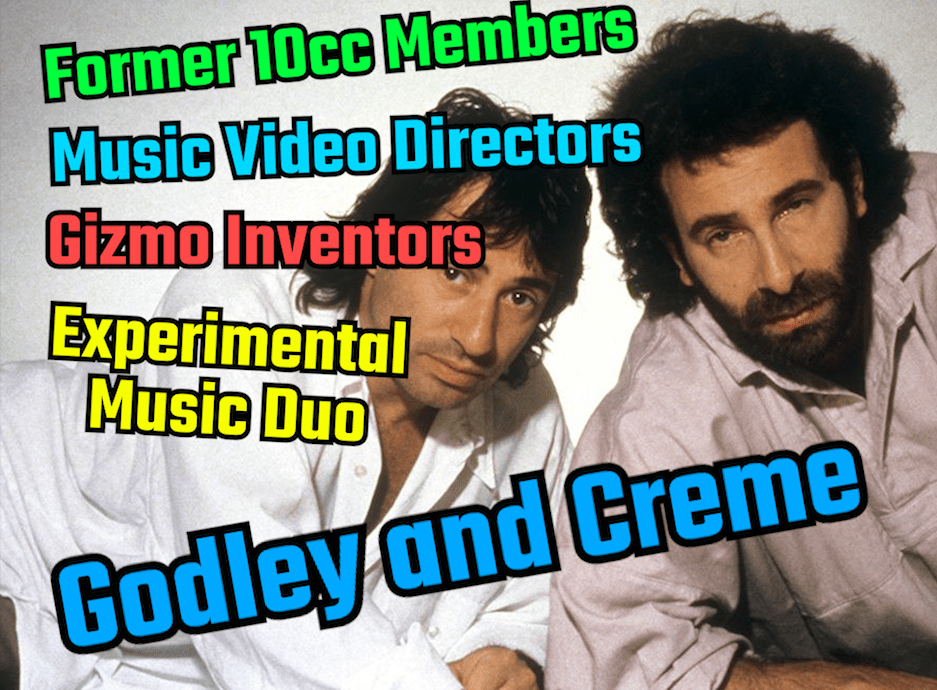
I discuss the story, discography, and career of Godley and Creme. Former members of the band 10cc that went on to direct music videos, invent the gizmo and create 7 studio albums together.
Kevin Godley was born October 7th, 1945 and a couple years later in Prestwich Lancashire England, Lol Creme was born on September 19th 1947. The two met in the late 50’s, attended Art schools majoring in Graphic Design and collaborated several times throughout their young lives with film and music projects. Lol Creme joined a Rhythm and Blues group called The Sabres as a guitarist and Kevin Godley soon joined on the drums though they were only in the band for a short time. (The Sabres went on to find success as The Magic Lanterns.)
Through that experience they met fellow future 10cc member Graham Gouldman who they collaborated with in many ways over the years and Godley played with in The Mockingbirds. Already successful at selling his own compositions, Gouldman re-polished one of Godley and Creme’s filmscore songs and it became a hit for Wayne Fontana in 1966. A couple of years later, Godley and Creme would officially release a single together under the name The Yellow Bellow Room Boom and since they didn’t actually have a full band, the label did some promotional material with a band of impersonators. The psychedelic folk single didn’t launch them to instant stardom but it showed off their talent and Godley’s voice so after contributing to a sampler album and recording another single that wasn’t released at the time, (Show images of Marmalade 100) they were eventually recording a full length album for Marmalade Records at Strawberry Studios with the help of Eric Stewart and Graham Gouldman.
Unfortunately, not long after releasing a single from the upcoming album under the name Frabjoy and Runcible Spoon in September 1969, Marmalade Records collapsed and the Frabjoy and Runcible Spoon album was shelved for over 50 years, finally being released in June of 2022 as part of a compilation called “Frabjous Days: The Secret World of Godley and Creme 1967-1969”
In my video about 10cc I covered how the lads got tons of studio experience working with all kinds of musicians and projects at Strawberry Studios. Eventually while Graham Gouldman was working in the US, Eric Stewart with Godley and Creme experimented in the studio and created a hit song with “Neanderthal Man” under the name Hotlegs. An album and a tour with Gouldman’s help would follow and this evolved into 10cc. These four incredibly talented songwriters crafted four excellent art rock albums together in which they all played different instruments, experimented with production techniques, and sang different lead and harmony sections with wonderfully clever and witty lyrics. If you’d like to learn more about that, please watch my video about 10cc after this video. Thank you!
Now that the past is out of the way, we can get into the meat of why we’re here today.
Back in 1969, Godley and Creme started inventing a device they called the gizmo in order to replicate the sounds of a violin or cello using spinning wheels on an electric guitar so that they wouldn’t have to hire session players and because Lol Creme often joked about wanting an orchestra for his birthday. They initially experimented with Godley applying a drill to Creme’s guitar strings and they later took the idea to John McConnell at the University of Manchester Institute of Science and Technology for further help developing the unit. By 1976, the duo had used their device several times in 10cc and were looking to capitalize on the invention and bring it to market alongside an EP that would show off it’s capabilities. This passion project would ultimately consume so much of their time that they decided they needed to leave their band in order to properly pursue it.
After making plans to eventually release what they will call the Gizmotron with a company called Musitronics, the planned EP would mix with another idea that had been in the back of their heads and it ended up becoming a triple album that included a comical radio drama interspersed with songs that feature the Gizmo.
“Consequences” was recorded over a period of 18 months in which Godley and Creme basically had blinders on to the outside world as they got stoned and focused all their energy on experimenting with the Gizmo, engineer Martin Lawrence and other eventual collaborators. Kevin Godley became the duo’s lead vocalist though Lol Creme sings at times as well. Godley plays all sorts of percussion and Creme played all sorts of pianos and guitars including bass. They had originally wanted an all star cast to perform a radio drama but when comedian Peter Cook joined the project, it was clear that not only could he write the production but he could perform all of the male voices with plenty of variety.
When the massive album was released in October of 1977, it had a hefty price tag in comparison to a normal sized album. Combine that with how unusual this album is and well, it was a major flop. But Godley and Creme didn’t regret being true to themselves and getting this epic piece of artwork out of their system.
The first disc is largely instrumental with some of it being entirely created by gizmotron along with studio effects or Gizmo with drums and sometimes alongside other instruments or studio experimentation. The music on this disc is very progressive and often blends together from track to track while intending to recreate the scenes of weather destruction that tell the more worldwide perspective of this album’s story line.
The second disc, or the third side to this album, begins with an actual song. A gorgeous, piano based song that reminds us that these guys were half of 10cc. After this is when the radio drama would begin. We meet 2 divorce attorneys and their clients and learn that there is a hole in the floor that attaches to the attic of a peculiar pianist named Mr. Blint. In the end, the matter of how many teeth Lulu has is of no consequence while the world is being ravaged by apocalyptic weather.
Sides 3, 4, and 5 consist of this comical play with some really great songs in between sections of dialogue that help add context and flavor to what is happening in the radio drama. Some of the dialogue has musical accompaniment, but not much of it. When we finally get to the 6th and final side, it is Mr. Blint’s 17 movement symphony intended to restore the world to order. This epic 14 minute track has some callbacks to themes heard earlier in the album and is loaded with great sounds and melodies on the gizmotron often accompanied by drums or piano.
As you can tell, this is a long album, coming in at almost 2 hours long and it is not necessarily everyone’s idea of a good time. My advice is to take in chunks and not listen to it in one sitting though I can imagine there are those who think that is blasphemous. This album received a lot really negative reviews killing any potential of success at it’s high price tag but many that purchased the album still think of it as an incredibly ambitious masterpiece to this day.
I’m personally a little bit in the middle, though I lean towards believing it is a masterpiece, just a very odd one that I think grows on you more and more over time. I think I will listen to the radio drama occasionally throughout the years but I’m more likely to turn on the first disc alone, Mr. Blint’s Tune or 1979’s compilation album in order to hear the best songs that are mixed into the radio drama.
There is obviously a lot more to be said about this album than we should discuss here, but they did a ton of weird stuff in the studio, including shoveling sand for the burial scene, dropping bits of plasticine into water to start The Flood, getting the Gizmo to sound like a saxophone and much more. Outside of “The Flood” and some of the other best instrumental parts, a few highlights from this album are the songs “It’s 5 o’clock in the morning,” “When Things Go Wrong” Featuring Mel Collins on Sax and “Lost Weekend” which features legendary jazz singer Sarah Vaughan.
The final thing I want to mention about “Consequences” for now is that Godley and Creme with their art school background also created all of the album’s visual artwork through interesting experimental methods that included cotton wool for clouds and glass for waves.
(notes about what studios they recorded and how they did audio at strawberry at night and visuals during day)
After the flop of “Consequences,” Mercury Records understandably wanted them to release something a little more commercial and the boys lied claiming that they had tons of songs ready for once they’re back in the studio. By this time though, they had become accustomed to recording ideas instantly and just building onto the track and so when they went into the studio with no ideas, they just got back to playing around, created some type of distorted bass drum track and started adding layers on top of it.
Though they were glad to have “Consequences” out of their systems whether it was a success or not, starting any other project at this point felt very anti-climactic but as work on their next album progressed, they were enjoying themselves more and more.
As they always did with any project, Godley and Creme pushed themselves to learn and try new things and during these studio sessions there was a day when Kevin Godley took the day off so Lol Creme recorded some drums and when Godley was there without Creme one day, he recorded the great basslines heard on the song “Group Life,” which makes me wonder why we didn’t hear him play bass more often. Godley also played a fair amount of Xylophone.
Their next album, “L” was released in August of 1978 and has a cover similar to a sign used on vehicles to designate that it is a beginner, or learning, driver. This album is less than 35 minutes in length Godley and Creme returns to an art pop, progressive rock sensibility but each song is very different and it is hard to place what genre these guys are.
So that I don’t rave about this album too much, I’m just going to say that I’ve listened to this album possibly over 50 times in the last half year, sometimes back to back because it is just that good. It is very unique and has a ton of variety and a lot of complexity in the compositions. Oddly, I had been delaying listening to it as for whatever reason I was convinced in my head that it couldn’t be as good as Godley and Creme’s 3rd album, “Freeze Frame,” which I already adored, but I’m so happy that this album blew me away right from the beginning.
The first track is long and super progressive with lots of really unexpected changes, the subject matter is sensitive but as Godley and Creme do with most of their tracks that deal with a serious subjects, they use their witty lyrics and eccentric instrumentation to simply make it extremely entertaining as well as easier to approach.
I really love the odd and humorous seduction in “Sandwiches of You” and the song about a kid getting bullied, “Punchbag.” They also sing about working in the Hit Factory that is the music business, Art school, and life in 10cc.
Though the majority of the album was created by the duo, there are a couple of Sax players including Andy Mackay from Roxy Music and radio broadcaster, Paul Gambaccini plays a role called “Bad Samaritan” which reminds me of “The Central Scrutinizer” from “Joe’s Garage” but this album predates that. I don’t expect that Zappa got his idea from Godley and Creme but clearly the duo was a fan of Zappa and not only can it be heard in the music of this album, but they even sing about “Getting into Zappa” on “Art School Canteen.”
(Show some of the music video)
1979 saw the creation and release of their third album, “Freeze Frame” as well as their first music video which we’ll get into in a minute.
The album came out in November of 1979 and has some similarities to the previous LP in a sense but as usual, the duo try new ideas with every song and none of them are near the same experience. Guest stars on this release include Phil Manzanera who helped produce and perform on a few of the tracks, Paul McCartney who adds some backing vocals to the slow, psychedelic and gizmo heavy “Get Well Soon” and Rico Rodriguez plays trumpet and tuba on “An Englishman in New York”
One of the most notable tracks on this album is “I Pity Inanimate Objects” in which someone had brought an early version of a harmonizer into the studio. A device used for pitch correction like auto-tune. Kevin Godley sang the song’s incredibly strange lyrics in a monotone voice and Lol Creme tweaked it into the most extreme and inhuman melodies to make Godley sound like he is really putting himself into the shoes of.. inanimate objects… like shoes…
The B-Side to the single from this album, “Silent Running” is a hidden track in the middle of the B-side of the Netherlands version of the album though it doesn’t appear on any other version.
The single of course was the bizarre track called “An Englishman in New York,” and did fairly well in several countries. It contains lots of strange lyrics inspired by how absurd they thought New York was during their first trip there and is heavy in marimba and sax licks with thumping bass over repetitive clapping and fast hi-hat.
The duo had an idea for a film or music video to go along with the track. The record label gave them a budget and permission to film the video but since Godley and Creme had not professionally created a video before, they were given a director to work with, Derek Burbidge. At first, the duo were simply performers on set, taking everything in but by the end of the shoot, they were basically directing it themselves with Derek’s pointers. They also wanted to be a part of the editing process as they realized this was something that they should be doing themselves. Combining their art school background with their knowledge of the music world in this format seemed the perfect pathway for them to continue to experiment and explore new things.
I spent months researching for this video and spent hundreds of dollars on a Gizmo, which I’ll never regret! But if you appreciate all the effort I went through to bring you this information, please just take a quick second to click the “Like” button and consider subscribing to see more videos, thank you!
Throughout the ‘80s, not only did they always direct music videos for their own songs by themselves, but they became very sought after directors in the growing world of music videos before the dawn of MTV and during it’s first several years. They worked with tons of acts during the 80s including The Police, Wang Chung, George Harrison, Ringo Starr, Yes, Rush, Frankie Goes to Hollywood, Toyah, Asia, Peter Gabriel, Duran Duran, Elton John, 10cc and many more. One of the videos they directed for Herbie Hancock, “Rockit” won five MTV Video Music Awards and won two Billboard Video Music Awards in 1984. And you’ll never guess what they were competing against that year. (Show Thriller battle)
A year later, Godley was already openly expressing that the music video industry was no longer as usable of a tool for creative art as now that the companies were all in the game, formulas and money making were priority. Reflecting themes they’ve already sung about. “We’re all living in a Hit Factory”
Musicians would request that the duo help them with a music video and if Godley and Creme had an image for the video, they would consider the budget, filming schedule, and how they imagined the music looked. Wanting to do something new and different every time meant that it was hard to label them with one particular style, but a common idea is that they didn’t have much interest in representing the lyrics because they feel that part of the art is already getting across and so they would be more influenced by sounds and how they pair with imagery.
Meanwhile, though the product was far from perfect, an offshoot of the company Musitronics released The Gizmotron in 1979. Led Zeppelin, Siouxsie and The Banshees and The Church were among the groups to release at least one song featuring gizmo. Paul McCartney, who appeared on “Freeze Frame” also used the gizmo a couple of times, but back before it was released to the public. He used it on “I’m Carrying” from 1978’s “London Town” and it seems to be unclear if whether it was Paul or Lol who played on the track “Liverpool Lou” released by Paul’s brother’s band, The Scaffold.
Unfortunately, The Gizmotron wasn’t very unreliable, was difficult to get working properly, affected by different levels of humidity, and would fall apart or the wheels would wear out easily. They stopped being produced in 1981 shortly after a couple of unfortunate happenings for the company and it wouldn’t be until 2016 that a new company released the Gizmotron 2.0 with Kevin Godley’s approval.
(Talk about mine for half a second?)
Called “Snack Attack” in the US, October of 1981 would see the release of “Ismism.” though it had been recorded more than a year beforehand. Though there are still some progressive and avant elements here, we’re starting to hear the addition of drum machines, more new wave type elements, and more repetitive backing tracks. In comparison to “L,” “Freeze Frame” was starting to have more repetitious songs, but I feel that “Freeze Frame” does a much better job keeping me constantly entertained and not thinking about any repetition going on, but by the end of some of the songs on “Ismism,” I’m kind of sick of them.
All around, I still like “Ismism” and I think a ton of others do as well. The lyrics are really the most appealing thing here, with my repetition nit-pick being built around them telling 5 to 7 minute long stories over the same beat. I’m personally just not into that kind of thing and seek more progression in the music I listen to.
This album includes their highest charting U.K. single, “Under Your Thumb” which is a haunting, synth and drum machine heavy track that was referred to as being a “sinister tale of a man encountering a woman’s tortured soul”
The other single from this album also did fairly well. Again, I’m not entirely impressed musically by this kind of typical soul pop sounding song, but the lyrics about window shopping and wanting to avoid wedding bells are pretty funny.
Their next album, “Birds of Prey” was released in April of 1983 and suddenly Godley isn’t playing the drums anymore.. I appreciate that these guys constantly wanted to grow and change with the times, but there are things about the ‘80s, like drum machines, that just don’t do it for me.
I think the last song, “Out in the Cold” is really creepy and interesting and is probably the only song that I truly want to come back to. Though I do find some of the other lyrical themes amusing, especially “My Body the Car.”
This album and it’s single failed to chart but you may enjoy checking them out, “Samson” and “Save a Mountain for Me” which had a music video.
Beginning with the ending dialogue from “Consequences,” Godley and Creme’s 6th album, “History Mix Vol. 1” was released in 1985. A celebration of 25 years making music together, they took recordings from different eras of their life and stuck it into a blender then, as Lol Creme stated, “Got J. J. Jeczalik of Art of Noise to reprogram the sounds to a disco beat so we could dance at our party”
The highlight of the album though is when you’re basically listening to the bridge of “I’m Not in Love” and
instead of a final verse coming in, it changes to the album version of their most biggest worldwide hit, “Cry.” And man, is that a great song… The music video is possibly the most recognizable thing labeled under the name, Godley and Creme and it’s experimentation led to Michael Jackson expanding the idea with his much bigger budgets.
Included on a 1988 10cc and Godley and Creme video compilation, the guys had similarly remixed video to go along with basically the first half of the album including the video for “Cry,” so you’ll see Yes and Sting hanging out inside of a Herbie Hancock video, cause why not? Around 5:30
In January of 1986, the duo created a 3 part experiment called “Mondo Video” that comes out to being about 17 minutes long and I never thought watching someone smoke in a studio could be more fascinating.
They figured that every shot that you film typically creates some type of noise, so they created music after esetablishing what they wanted to film. Or something like that. Either way, the idea was that video would write music and music would write video.
Godley and Creme had made several TV appearances but they never actually performed their music live as they sort of played the studio as their instrument. But by 1988, in a time in which I believe they felt making video clips was getting in the way of them accomplishing a full feature-length film, the two were considering achieving a live band sound again for the first time in over 10 years. When auditioning harmonica players, they realized there was a much bigger world there than they had known about and that they could think outside of the box in this new territory for them. Harmonicas are typically a lead instrument but they created a band that utilized different types of harmonicas as a rythmic group. 2 performers were recorded for the album but at least one live TV performance includes a third Harmonica player along with the 3 backup singers that they acquired.
Needless to say, the final album to be recorded by the duo, 1988’s “Goodbye Blue Sky” is another oddity in music history, and not one that is guaranteed to please every listener.
There isn’t anything particularly bad about this album and I’m sure many people love It, but at this point I’m looking back like, “Wait.. How far have we come now from the stuff that I really loved?” I’m sorry, but this isn’t the height of 10cc or Godley and Creme’s first few years of follow up albums any more. We’re now with a couple of guys who are disappointed that their opportunities to make a movie never came through. They’re drifting apart, hanging out with different people and tired of their professional relationship being their highest priorities. They spent almost 3 decades finishing each other’s sentences and working like they had a single mind on all types of projects before finally parting ways.
Outside of other projects, Lol Creme did however go on to direct a Jamaican comedy in the ‘90s and later he played with Trevor Horn and J. J. Jeczalik’s band, Art of Noise. When not continuing to direct music videos, Kevin Godley has done so many other interesting things over the years that it may be worthy of a short video in the future. One of his most notable projects being “One World One Voice” in 1990 in which he was able to get musicians from all over the world to collaborate on one epic piece of music with video in order to raise awareness of environmental issues. This idea was followed by an iPad app meant to allow people to make music with others all over the world. He released an album with Graham Gouldman in 2006 and I’ve recently been enjoying his 2020 album, “Muscle Memory.”
If you haven’t seen it already, I have a video about 10cc that you can watch here or learn about a different interesting band by diving deeper into my channel. I appreciate you watching and hope very much that you’ll click the “Like” and subscribe buttons and maybe comment below telling me about your experiences with Godley and Creme or recommend a band you think I should do a video in this style for. Until next time, have a happy listening session!
 Sean's Music Hunt
Leave a comment