
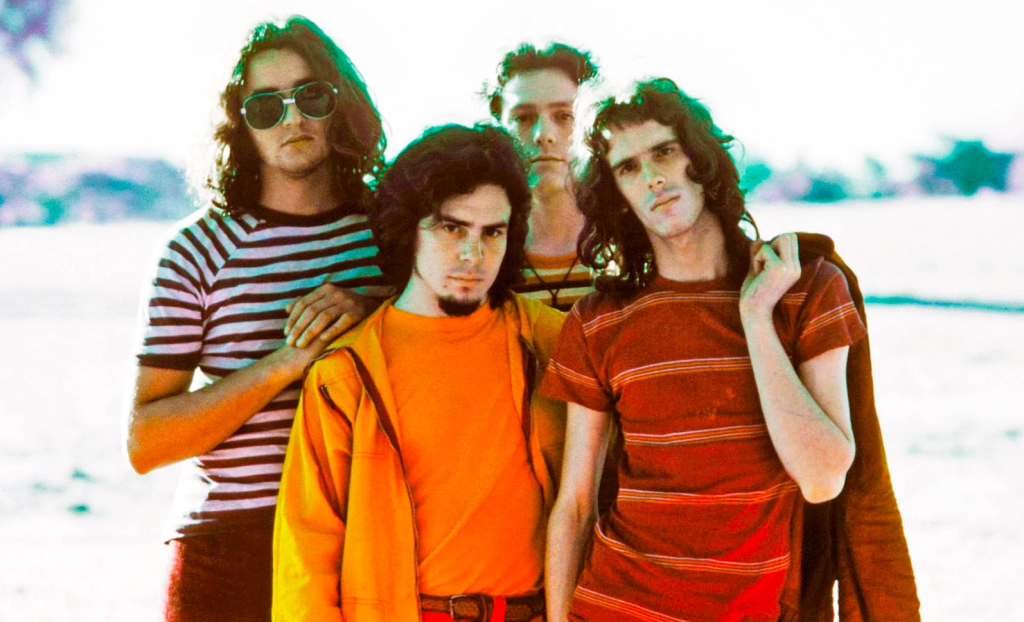
Shello everybody, my name is Sean and over the last few years I’ve become a big fan of Luis Alberto Spinetta. His album, Artaud is considered by many to be the greatest rock album ever from Argentina and he is an incredibly important and influential figure in the history of Argentine rock.
Today I’m telling the story of his early days and the incredible success of his first band, Almendra. This will be the beginning of a series about Spinetta’s different bands so be sure to click subscribe while my short intro plays!
Luis Alberto Spinetta was born in Buenos Aires on January 23rd, 1950. His father sang Tango music accompanied by guitarists and young Luis had a passion for Futball and imitating singers and copying musical sounds. He was encouraged to sing at family gatherings when he was 4 years old, at 10, he was pulled on stage at a carnival where he confidently sang a rock ‘n’ roll song in spanish without accompaniment, and before owning an instrument he was already writing songs.
One of the guitarists that played with his father gave him a few lessons, but for the most part, Spinetta is a self-taught guitarist that would hone his own style through the years.
When he was 14, he sang in a couple of different TV shows, eventually losing in the competition but winning enough money to buy himself a precious copy of “Beatles for Sale.” Oh so precious and life changing.
At 15 years old, in 1965, He joined a band called Los Larkin that was led by dummer Rodolfo Garcia who was four years older than Spinetta, having been born Febuary 13th of 1946 is Buenos Aires. Around the same time he became good friends with his classmate Emilio del Guercio. A bassist, guitarist and vocalist Born on the 12th of April in 1950 in Mar del Plata that was in a band called Los Spirros with guitarist and vocalist, Edelmiro Molinari who was born on July 8th, 1947. Both of these bands primarily sang in English.
Spinetta and Emilio del Guercio formed a duo called Bundlemen, where they would both sing and Luis would play his acoustic guitar. They would do covers of The Beatles and some originals in Spanish. They studied poetry and became somewhat of a songwriting duo, they also wrote and drew a satirical newspaper that was confiscated by the teachers that were often the butt of the joke.
Los Larkin changed their name to Los Mods and recorded two songs in English that were co written by Spinetta and no longer exist. By the end of 1966, the band would dissolve and eventually merged with members from Los Spirros to create a new band called The Beatniks with Luis on lead vocals, Emilio del Guercio on Bass, Edelmiro Molinari on guitar, Rodolfo Garcia on drums and Santiago Chago Novoa on keyboards. Rodolfo Garcia was recruited for military service while the others continued working on their other projects, Bundlemen and Los Spirros, with the expectation that their drummer would return.
During this time in 1967, Los Gatos released their successful version of “La Balsa” which is seen as the start of the style of rock from Argentina that is referred to as Rock Nacional. The song further proved that it was possible for a rock band to succeed without giving in to singing in English. Around this time, Spinetta had also heard that a friend of his with the nickname Pototo had died and the loneliness that comes with the thought that you’ll never see your friend again inspired him to write the song that would become his band’s first successful single, “Tema de Pototo.” Fortunately, there had been a mistake, Pototo had not died and when he returned from the school trip that Luis hadn’t been able to attend, Spinetta gave him a giant hug.
In March of 1968, Luis Alberto Spinetta joined his friends in Los Spirros as a guest at a concert where he was able to earn money for his first electric guitar. Just a few days later, Rodolfo Garcia was discharged from military service and The Beatniks began rehearsing daily at Spinetta’s parent’s house. Their keyboardist eventually stopped showing up for rehearsal to leave us with the classic 4-piece lineup. After considering different names including Aquelarre, the name Almendra was the clear winner as soon as it had been pitched. The band sang in Spanish and experimented by taking elements of local sounds like avant-garde tango and the popular folklore then adding influence from The Beatles and blues rockers like Cream and Jimi Hendrix.
Luis and Emilio attended a Los Gatos concert where they met producer and radio show host, Ricardo Kleiman. A few days later the band performed a song for him that Spinetta had written called “Where Are You Going Mary Sue?” Impressed with the group, they were brought into TNT studios on August 20th of 1968 to record a single for RCA Records using equipment borrowed from English beat band, The Tremeloes who were in Argentina at the time.
This single is quite the production with a lot of dynamics and unexpected changes on the first song with the additions of string and horn sections, a Farfisa Organ and backing vocals from all of the members. The B-Side is just as worthy of being an A-Side, it is loaded with brass, has a thumping bassline, tons of energy, and ends with a wah wah guitar solo.
Having proven his ability as an incredible songwriter, several of Luis’s songs were recorded by other artists on the RCA Victor Label that year including a version of “Tema de Pototo” made famous by Leonardo Favio but using the subtitle “Para Saber Como es la Soledad” and a band called Los In recorded a version of “Where are you going Mary Sue” for a compilation album in 1968.
Spinetta expressed to interviewers that musicians need to be authentic and sing in their own voice and the band started playing bigger shows as 1969 went on. Their performance at The Teatro del Globo had been recorded by the singer of Los In and was eventually released to the public in 2004. The performance contains several songs by Spinetta that were never professionally recorded by Almendra, though most were released in some form or other by different groups throughout the years.
The band released another single as well as some of the earliest music videos in Argentina for their songs, “El Mundo Entre Las Manos” “Campos Verdes” and “Final.” One of the songs the band had chosen to be a single was placed on a compilation album instead while the record label chose to release “Tema de Pototo” a second time with “Final” as a the B-Side.
When Spinetta showed his bandmates his new song, “Muchaha,” the other 3 began singing along and decided that the song with its delicate lyrics didn’t need anything other than Spinetta’s gentle guitar accompanied by four voices. This would be the first of several songs inspired by his first reciprocated love, Cristina Bustamante. Released on June 22nd of 1969, the song was an instant hit and is found at number 2 on lists of best rock songs from Argentina with an impact comparable to that of “Yesterday” by The Beatles.
An advertisement helped boost the single. The songs appealed to the youth in Argentina and began spreading to neighboring countries as well. The B-Side of this single is the song that initially caught my ear with this band, the heavy psychedelic blues rocker, “Ana no Duerme.”
These two songs would appear on the band’s self titled debut album released on November 29th, 1969. Luis drew the album cover of a man in a Pink shirt with the band’s name on it. He has a toy arrow on his head and a tear running down from his eye. As you dive into the record, you learn that the eye, tear, and arrow are used to separate the songs into 3 categories. The eye represents songs that the man on the cover sings while unconscious in the void, Songs with the Teardrop are as bright or within the brightness of the thousand-year-old teardrop. While the toy arrow represents songs that men sing to that tear of the man on the cover, tied to their destinies. The translation is a little rough but the idea is certainly interesting.
The record label was turned off by the cover and initially shelved or intentionally lost it because they felt an image of the band would sell better but Spinetta redrew the cover and insisted that they use it as he had clearly thought it out and didn’t feel record executives should have their hand in the artwork.
The majority of the album is written and sung by Luis Alberto Spinetta though Emilio del Guercio sings on two of the tracks and wrote the beautiful and catchy song, “Que el Viento Borro tus Manos” that he sings as well as provides the excellent flute. And Edelmiro Molinari gives us a hint of his future career with his 9 minute heavy rocker “Color Humano” that includes a 5 minute guitar solo. All of the songs on this record offer something different and are totally wonderful. A couple more stand out tracks include the gentle “Plegaria para un Nino Dormido” or “Prayer for a sleeping child” and the innovative “Laura Va” with remarkable orchestral arrangements by Rodolfo Alchourron and Rodolfo Mederos on the bandoneon. Edelmiro Molinari and Rodolfo Garcia also added some organ and piano and Spinetta plays some harmonica at the end of one of the tracks.
The album was very impactful on Argentine popular music, opening a new dimension to the future and currently appearing at number 6 on lists of best rock albums of all time from Argentina. But of course there is always some press with negativity to throw around which opened Spinetta’s eyes to lies and agendas in the media, forever creating a distrusting relationship.
Being a constantly growing artist Spinetta crafted an ambitious rock opera to be released in mid 1970 with characters played by Litto Nebbia, Moris, Tanguito, Javier Martinez, Roque Narvaja and Miguel Abuelo. It was to be titled “Senor de las Latas” and Spinetta would have played the Water Wizard, of course.
Unfortunately it seems this is when the band began to crumble. Disagreements arose around which direction to take the band, they started rehearsing less regularly, and tours and shows were creating tensions and wearing them down. Spinetta became depressed and the band was only ever able to finish rehearsing the first two acts of the opera before shelving it and ultimately breaking up in September. A few of the songs written for the opera can be heard later in Spinetta’s career though the only song we hear from Almendra is the Overture which can be found on the double album that was released on December 9th of 1970, 3 months after the band broke up.
There is even more variety in this self-titled album that is usually referred to as Almendra II or Almendra’s double. Emilio and Edelmiro both contribute several songs to the album though more than half of the record contains songs by Luis plus two songs credited to both Emilio and Luis. The band took influence from another monumental album from Argentina by the group Manal and Luis experimented with writing songs on LSD though the others did not partake. The album is more electric and heavier than the previous one for the most part and contains quite a bit of psychedelia. One of the songs has 12 minutes of improvised psychedelic blues rock after a couple of minutes of awesomely psychedelic progressive folk rock written by Spinetta.
I won’t get too in depth on this album as there is a lot to take in, but some of the stand out tracks are “Los Elefantes,” “Parvas,” and the Manal inspired “Rutas Argentinas” which became somewhat of a theme for the country. The cover has a maze drawn by Spinetta with a green crayon which somewhat symbolizes the uncertain artistic course found on this album.
Luis and his girlfriend Cristina had broken up and he had a period in which he felt like he should just be a bassist in the background. He began hanging out with some of the guys from a band called “Los Abuelos de la Nada” and started a trio called Agresivos with Hector “Pomo” Lorenzo on drums who would join Spinetta for a couple of bands in the future as well as singer and guitarist Norberto Napolitano, better known as Pappo. Though Spinetta was a couple months older than Pappo, Pappo was very talented and had played in Los Gatos for a time so Spinetta looked up to him and was inspired that he was creating heavy blues based rock that opposed the commercial sensibilities.
Together, these three would record with others for Pappo’s first solo song released on a compilation album in 1970 and they joined Black Amaya when recording a song that Spinetta wrote for Billy Bond y La Pasada del Rock and Roll’s first album. Billy Bond sings on the track while Spinetta provides bass.
Almendra was still under contract for another album through RCA and Spinetta decided to record a short experimental album consisting of material that was improvised or written on the spot. Though it also includes a couple of blues rock songs written by Pappo, “Era de Tontos” and “Castillo de Piedra.” Pappo is not credited for writing the songs and later recorded versions of “Castillo de Piedra” with the title “Tema 1.”
The album was recorded in 30 hours of studio time in February of 1971 with a large number of guests in the studio during tracks that were inspired by the communal recording of “Give Peace a Chance” by John Lennon and Yoko Ono. Miguel Abuelo from “Los Abuelos de la Nada” appears on a couple of the tracks adding flute, his voice and some percussion.
This album is highly psychedelic at times but also very stripped down and raw and though it may not be a masterpiece, it was certainly an interesting listen.
The album was released in March of 1971 but the record label had ignored Spinetta’s cover and title and instead branded it as an Almendra album with a picture of the classic 4-piece on the cover. Luis and Almendra sued the label and had the album withdrawn. Multiple versions of the album were released throughout the years but it wasn’t until the ‘90s that a CD version with Spinetta’s actual title finally arrived.
During the ‘70s the members of the band all went on to perform in different bands which I will be covering on this channel in the future so be sure to subscribe to learn all of the details, but Edelmiro created his band Color Humano, named after the classic song from the Almendra album. While Rodolfo Garcia and Emilio del Guercio played together in a group called Aquelarre. Spinetta’s next couple of bands will be up next in this series so be sure to subscribe to follow along.
But in December of 1979, the band regrouped for 2 concerts at The Obras Stadium which were recorded for a live album released in 1980 as well as filmed for a project that never came together. Thousands more people than anticipated were dying to see this classic band back in action and they decided to stick together to go on tour and even create another studio album titled, “El Valle Interior.”
The album is understandably very different from the Almendra we had heard ten years prior. These guys now ranged between 30 and 34 years old and had ten years of new experiences and changes of musical direction to pull from. Overall the album is more of a progressive pop rock album with elements of jazz. Emilio wrote two of the tracks while the rest was written by Spinetta. The drawing on the cover was done by cartoonist Eduardo Santellán of a historical hotel that had recently closed down but was recognizable due to being used in imagery for a popular brand of mineral water named after the region. This idea came from Emilio del Guercio who wanted the average person in Argentina to connect with it. I only really recommend this album to completionists or fans of Spinetta’s later solo career.
Almendra would go on a tour of 32 cities which was pretty massive for a South American band at the time but unfortunately conflict arose between Spinetta and Molinaro and the band performed a farewell concert at a festival in February of 1981.
Fast forward to 2009 and the band would reunite again for a final time in public near the end of Spinetta’s legendary 3 hour long concert that was released as a box set with the title, “Spinetta y Las Bandas Eternas” or “Spinetta and the eternal bands.”
Emilio del Guercio created and hosted a show called “Como Hice” that discussed the history of great songs and the band appeared together on an episode about “Muchacha (Ojos de Papel)” that was recorded a couple years before Luis Alberto Spinetta passed away from lung cancer at the age of 62 on February 8th, 2012. Rodolfo Garcia passed away on May 4th of 2021 at the age of 75 due to a stroke.
If you’re wondering where to start listening to this band I would definitely start with the first album, though if you want you can also easily find the reissued version of the album that contains all of the band’s singles alongside the classic album and that is a really great way to go about it if you’re wanting more content. If you enjoy that first album, definitely move right along to the next one.
Thank you so much for watching this video, I’d really appreciate it if you could hit the “Like” button if you enjoyed the video, leave a comment letting me know what you think and which band I should make a video about then be sure to subscribe so that you can catch my next videos in this series and until I see ya again, have a happy listening session!
Buy this group’s albums on Amazon: https://amzn.to/3JtJGSL
 Sean's Music Hunt
Leave a comment